
How to Disagree and Not Destroy

How to Disagree and Not Destroy
I spend a lot of time of late grieving over the state of public discourse in my home culture and even in the church. I miss civil dialogue with people who could disagree openly without trying to destroy each other. Have you ever had someone who made you a better person by regularly disagreeing with you in a loving way? I have.
I had a wonderfully complicated relationship with former Brazilian missionary, preacher, professor, and international leader Dr. Howard Norton. I loved and respected him and always felt loved and respected by him. But we always seemed to be on the opposite end of every disputable issue.
When I moved to Norman, Oklahoma in 1994, at the ripe old age of 28, to serve as Preaching Minister for the Alameda Church of Christ, I was the progressive change-agent at the most “liberal” church of our fellowship on the south side of the OKC metro area. (Calling any Oklahoma CoC “liberal” in those days was humorous.) Dr. Norton was the Dean of the College of Bible at Oklahoma Christian University and was a loyal centrist leaning conservative. We interacted cordially from time to time, but we stepped around each other carefully, trying to keep any conversation in areas of agreement. He was always kind and respectful despite my youth and lack of experience.
However, when I took the role as Senior Minister for the Central Church of Christ in Amarillo Texas in 2001, I was put in a more difficult position vis-à-vis Dr. Norton. Central was and is the overseeing church for Great Cities Missions, and Howard was a legend on GCM’s board. When I was added to the board as a special church advisor, our different perspectives were constantly in tension. I was too impetuous to hold my opinions to myself.
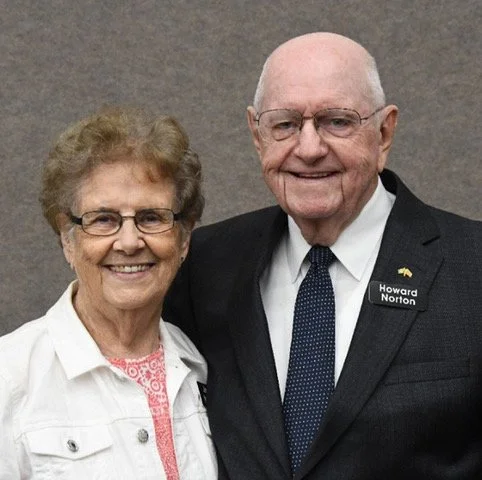
Dr. Norton was a key leader on the 1961 São Paulo team that represented the inaugural mission team in GCM’s history. I was born five years after that team landed. Howard was the consummate “company man” who trusted the established best practices of the ministry. His perspective was rooted in vast experience—including knowledge of painful mistakes and failures to avoid. I was a voice for adapting to a new global reality but had no personal long term on-field experience.
Yet, when the GCM ministry staff wanted to make big changes, they would prime me to support their proposals, which I was generally glad to do. Howard and I regularly ended up on the opposite side of every tense conversation. I was outmanned and outvoted routinely. Dr. Norton’s voice appropriately carried tremendous weight.
Then in 2007, GCM had a joint board meeting with MRN, and I was asked to present a book review and application of Jim Collin’s book, Good to Great. I thought it went well, and it prompted a good discussion. As you can imagine, I was advocating a change-or-die mentality. The next morning, when Howard was scheduled to speak, he set aside his planned presentation to rebut me point by point for an hour. To say this was awkward would be an understatement.
But here is the thing; Howard was amazingly gracious to me before, during, and after. It was never personal. He disagreed with what I said, but he loved and honored me as a man and brother.
Fast forward to 2009. I went to Honduras with our son Seth as part of Christian Relief Fund, where I also served as trustee. At that time, Howard was serving as sort of a long-term interim President of the Baxter Institute—a minister training institution for the Spanish speaking countries of Latin America. When I contacted Howard about dropping by, he was elated. He convened the entire faculty and student body and asked me to speak to them. From his introduction of me, you would think I was some celebrity or royalty. He made me sound like the most important preacher in the USA. He then trusted me to say whatever I wanted to the whole school. He and his wife Jane took us to eat afterwards and came all the way to the airport see us off on our way out a few days later.
Howard Norton was gracious man of God who showed me how to disagree in love. We thought differently about a lot issues—many of which we both thought to be important, and most of which I can’t remember. But we were brothers and friends and we loved each other. We could argue and advocate for different directions publicly but never attack each other (in public or in private). Howard taught me how to do that. He modeled a gracious and principled leader who speaks up without lashing out. Howard helped me rethink many of my ideas for change, and he helped me understand the value of what had been done before. Mostly, he helped me understand how to love younger leaders who would come behind me and want to change things I had done. That matters to me a lot now that I’m in my 60s.
I miss those days, and I miss my friend. I hate living in a time of polarization, character assassination, evasion (distancing and avoidance), and subversive manipulation. I miss civil dialogue and respectful disagreement. This needed practice is sadly missing in the USA culture and in the church. But it doesn’t have to be this way. I’ll always be grateful to my favorite critic for teaching this to me.