Recovering Ascension as an Essential Ministry Move

Recovering Ascension as an Essential Ministry Move
Over a decade ago, I was with a coworker in a European country that had once had a vibrant church culture but was struggling after the death of their larger-than-life national leader. My co-worker, who was intimately aware of the situation, told me that the former great leader inadvertently set up the church for the struggle because he allowed everything to be built on his unique gifts, skills, and relationships. When he passed on, he had not trained or set up anyone to take his place. My co-worker’s summary of the situation was, “Nothing grows in the shade.” Ironically, the strength of the key leader cast too big a shadow, and his strength became the weakness of the church when he was gone.
This is a common problem all over the world. Leadership succession is just hard, regardless of where you live in the world, or what era of time you inhabit.
For a long time, I have advocated for us to embrace an approach to ministry and mission that follows the model of Jesus in the gospel narrative, which can be summarized as Incarnation, Crucifixion, Resurrection, and Ascension. [i]
Incarnation (God coming in human form) is about the gospel showing up in the forms of the local culture. This is contextualization. It models “God with us.” The kingdom workers and churches they lead are the temple of the Holy Spirit in that culture. The believers need to imitate the life of Jesus in ways that make sense in that culture. Jesus’ life and teachings matter as much as his death, and the life of Jesus continues through his second body—his second incarnation.
Crucifixion means that the leaders and churches that emerge out of their service must be willing to sacrifice for the sake of others. This is the process of dying to self. Paying whatever price it takes. It involves embracing weakness, vulnerability, powerlessness, shame, and at times martyrdom as Christ did to demonstrate God’s love and faithfulness. The kingdom never comes without great cost.
Resurrection means trusting God to raise up something we can’t produce in the wake of the sacrifice of ministry. It means depending on God’s power not our strategy. It involves embracing waiting and grieving in hope. It means not being afraid to look powerless and hopeless to those who don’t understand, including at times to the church itself. When God does move and raises up a dynamic body in that place, it is manifestly God’s work, and the honor belongs to him alone.
This is where a lot of us lose the plot. Yet there is another act in this play: Ascension. Jesus didn’t remain on the earth in bodily form to manage the church. Rather he entrusted other leaders he had discipled, went to the Father’s side, and sent his Spirit to guide and support those he raised up in his absence. That means good leaders who want to be like Christ must develop other leaders, leave, let go, and support from some distance. It means doing ministry from day one with an awareness that you will not always be present. It means faithful leadership doesn’t hover and control, but constantly develops others and gives away leadership to them. It means staying connected and supporting spiritually, while empowering, entrusting, and releasing.

We tend to think the crucifixion step is the most difficult step of leadership, but I’m not so sure. Incarnation is hard, crucifixion is costly, and resurrection requires demanding faith, but ascension may be the greatest challenge for ministry leaders. Ascension requires letting go of something we have sacrificed and suffered to see be born and grow up. It means letting go of power, reputation, and honor to Jesus who really deserves it.
But we are called to be midwives in God’s maternity ward, not parents. Jesus told us, “Do not call anyone on earth ‘father,’ for you have one Father, and he is in heaven (Matt. 23:9).” Many leaders know how to start and run ministries; few know how to release them. We too often get our identity and sense of value from our work, and it is just too hard to let it go. That is the sacrifice many leaders aren’t willing to endure for the sake of the mission.
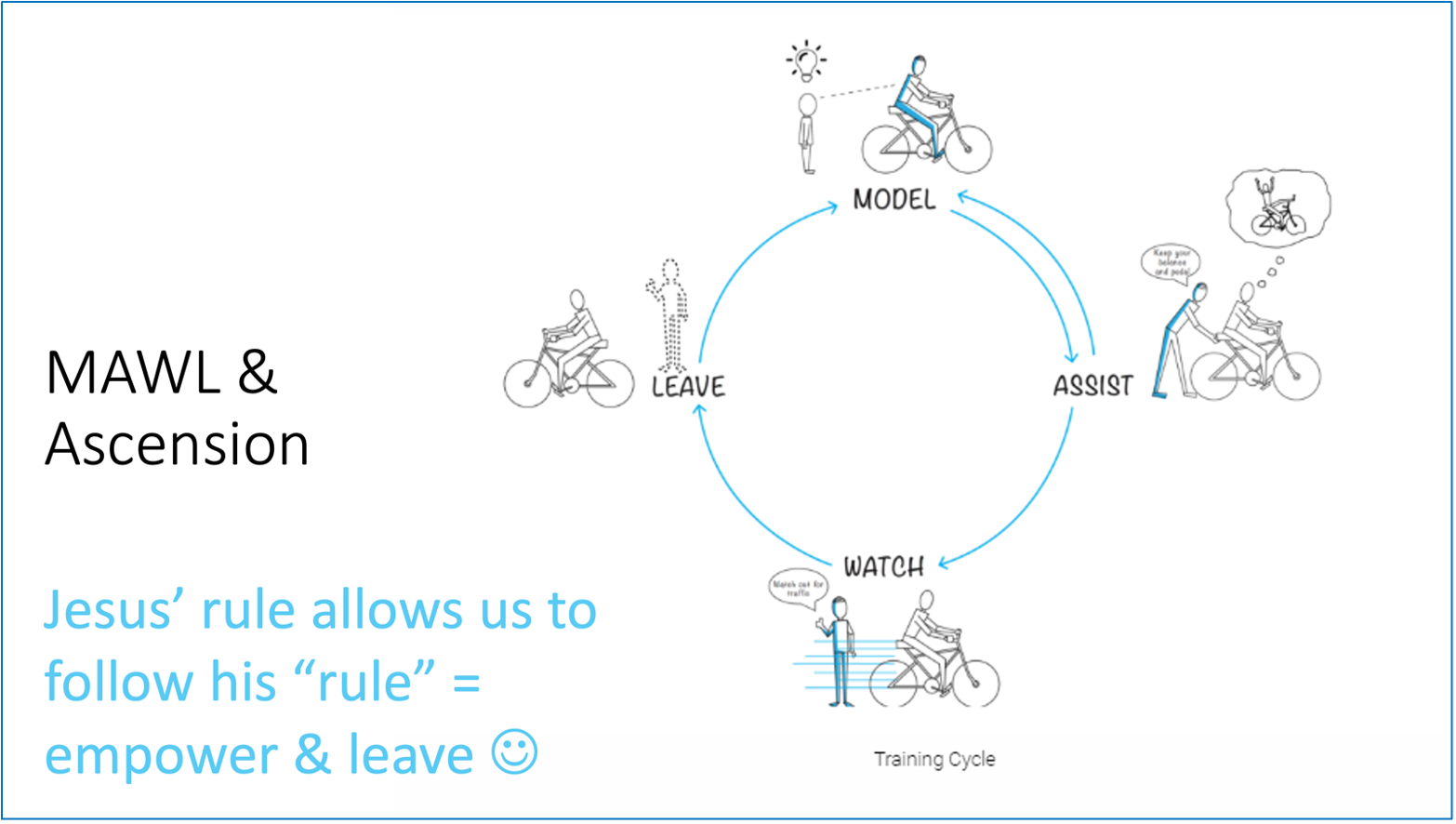
Yet good kingdom workers don’t move up; they move out and let go. They don’t sit enthroned at the top of a ministry pyramid. Instead, their conviction about Christ’s enthronement (Ascension) allows them to follow Christ’s rule of empowering others to lead. They constantly develop other leaders and move to support from the side as soon as possible. God has called us to be fishermen who catch and release. If we want to see the kingdom grow exponentially, we must invest in others and release them to be under God’s leadership, not ours. [ii]
The hardest move for committed kingdom workers is releasing control and trusting God with his church and his people. It’s crazy, even humorous that we struggle with this when you think about it. If the Son of God can step away and allow others to step up, why would any of us assume we are irreplaceable? Can’t God be trusted to lead and protect his children and his bride? Please. We know better. Let’s complete the story and embrace Ascension in our Christ-like model of kingdom service.
[i] For a fuller version of this model, check out The Jesus Moves Inventory, click here.
[ii] In our training of cross-cultural workers at MRN, we talk about the MAWL model of Model, Assist, Watch, and Leave.