
Getting Team Needs Met

by Alan Howell
Director of Church Relations
Whenever I talk with kingdom workers serving on the field one of the most important questions that I will ask is this:
How are you getting your team needs met?
From the very beginning, disciples of Jesus have been sent out in teams. Having teammates as partners we can rely on isn’t just nice, it is necessary. But finding or forming teams (especially these days!) and figuring out how to work well together can be difficult.
At MRN we believe that there are four crucial areas of team relationship needs:
Strategy: Team members provide strategic partnership and accountability as they work together to accomplish the same goal. Each member brings a unique gift to the team, creating a more powerful ministry together. Planning, synergy, and collaboration contribute to the ways team members are able to accomplish a common vision.
Safety: Cross-cultural workers will rely and depend on those they can trust in times of crisis or need. In an emergency, these team members are often called first for help and support. In foreign environments, this type of security and trust is vital for staying mentally and physically healthy on the mission field. Beyond physical safety, team members in certain contexts also must be counted on for important roles such as protecting visa status and safeguarding the workers’ identities to remain in the country.
Spiritual: Team members encourage one another and provide spiritual community. These types of team relationships provide members with a nourishing spiritual environment that facilitates growth. This means providing appropriate accountability and spiritual support.
Social: Team members contribute to emotional and social well-being. Interaction with teammates of similar cultural backgrounds in a cross-cultural setting is often important to pursue (when possible) for good mental health. Fellowship, sharing meals, having fun, and other social interactions are also important aspects of the team.
Since there is no “one size fits all” team pattern for every context, it is important to consider how teammates may be called upon to provide those elements to varying degrees. People bring different needs with them, and those needs will even change over time. For example, a Kingdom worker may need more social support from a team in the beginning years of service then need less as they form relationships locally. Their need for team strategic support, on the other hand, may actually increase over time... or vice versa. In the same way that we should expect teams to shift and change, the types of support they provide the members will not be static either.
A related dynamic to consider is how those community needs (strategy, security, spiritual, social) are met from within the team community and/or with people in that context but outside of the team. Assuming the team will fully meet all those needs will put more weight on the mission team than it was meant to bear. It may lead to overreliance on the team, causing Kingdom workers not to engage in meaningful, impactful relationships with those in the local community.
This is an important tension for mission teams to manage: How do we make sure to bring with us the community that will sustain us, but in ways that won’t strain us, drain us, or detain us from finding the local community that will enter new terrain with us?
Creating alignment on this and shared understanding about how different people have different areas of team need is important. Consider this case study:
Imagine two families, Kingdom workers and teammates, move to a new city at the same time. One family has children; this couple tends to be more introverted and have a smaller social battery. They are methodical and dedicated to systematically learning the language, but they lack the bandwidth for forming many ministry relationships at that beginning stage.
Their teammates, though, are recently married and don’t have children. They have higher energy levels and a much broader capacity for connecting with people in this season of language and culture learning. The couple with children always wants to have team meetings at their house, since the kids have a space to nap and play. The other couple begins to resent catching multiple buses every week to get across town for the meetings, and they feel those meetings get in the way of the connections they are already making in the city.
Can you see why conflict is emerging and how it could lead to the breakup of a Kingdom partnership, not long after launching to the field?
In order to help mission workers and the churches and believers that send them, MRN has created a Team Formation Field Guide to walk through defining what a team is for, the discovery of who to form a team with and how to work together, and what it can look like to develop plans and processes to set everyone up for success in the areas of team relationship needs.
This resource is for people who have a team and those who hope to find teammates where they will launch to. It also looks at topics like developing teams in complicated, multicultural contexts. There is plenty of space in the 54-page field guide for recording reflections, developing action items, and conversation starters.
We also are excited to share the accompanying "Team Discernment Expectations Inventory" - a useful way to help potential and current kingdom workers have important conversations and develop the relationships that they need to flourish.
The free results from the Team Discernment Expectations Inventory will be sent to your email inbox with a chart reflecting how you rated four different areas of team relationship needs.
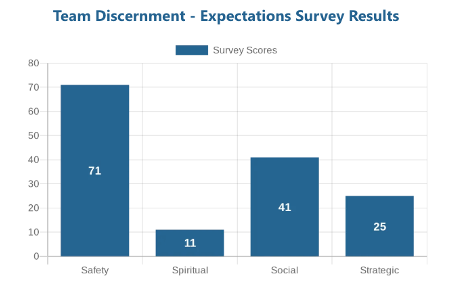
Check out this sample result →
These free team resources have already proven helpful with workers in our cohorts and supporting kingdom workers on the field.
For more information, go to https://www.mrnet.org/team-formation or email Alan Howell at alan.howell@mrnet.org